On Shavteli Street, a deliberately crooked tower built by a filmmaker-turned-puppeteer sends out a golden angel every hour — and twice a day, two tiny dolls act out an entire human life.
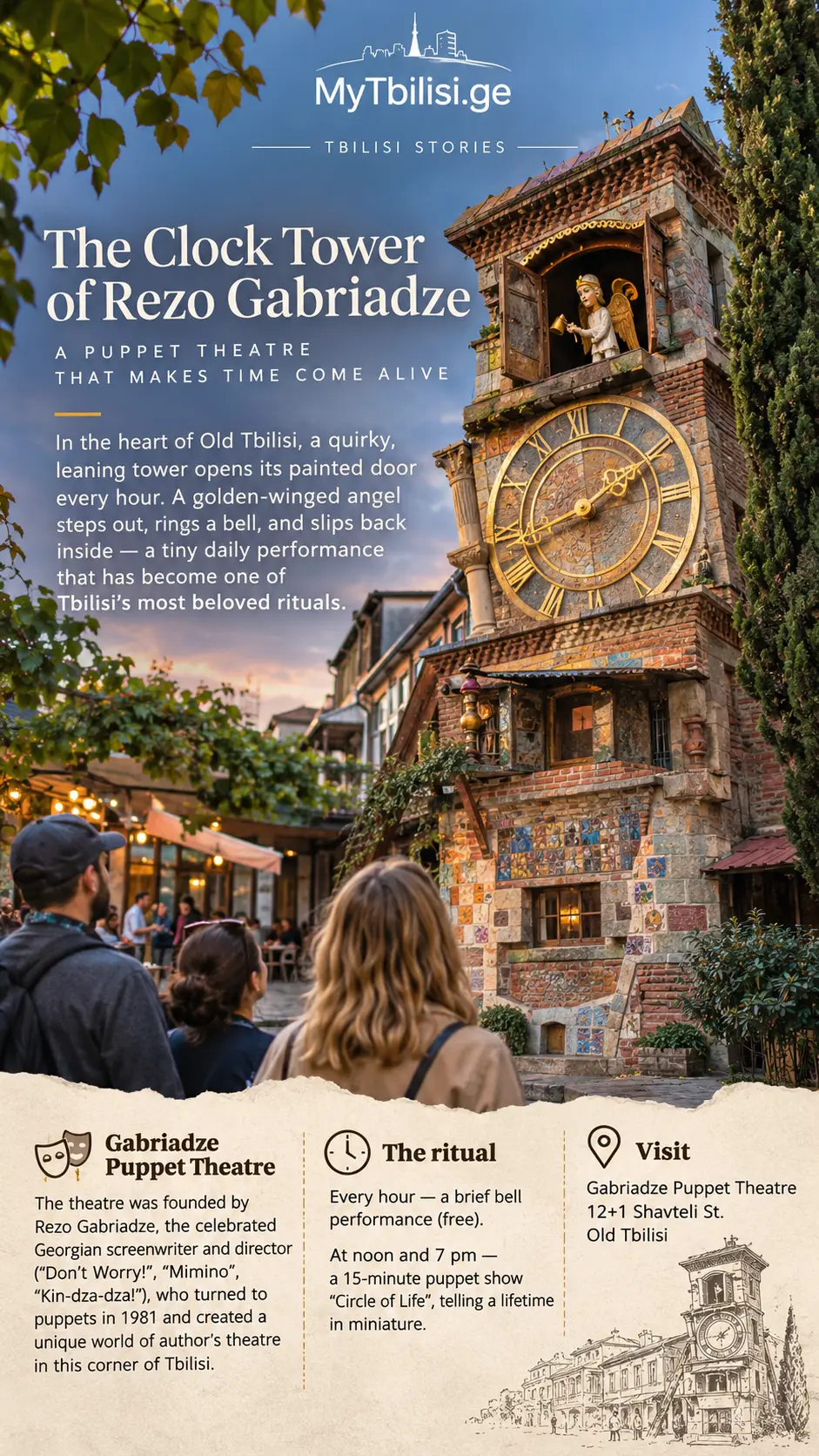
At the top of every hour, a small crowd gathers on Shavteli Street in Old Tbilisi and tilts its head back. A narrow brick tower, leaning just enough to look unsafe, creaks open a painted door. A golden-winged angel steps out, lifts a little hammer, and rings a bell. Then it withdraws, the door closes, and everyone goes back to their coffee until the next hour comes around.
The tower looks like it has stood here for centuries, patched together from someone else's ruins. It was actually built in 2010, by a film director who had decided, in his seventies, that puppets suited him better than people.
A screenwriter who went back to puppets
Rezo Gabriadze was born in Kutaisi in 1936 and trained first in philology, then in screenwriting and directing in Moscow. By the 1970s he was one of Soviet Georgian cinema's most celebrated writers, co-writing the comedy Don't Worry! with Georgiy Danelia and later scripting Mimino and the surreal sci-fi satire Kin-dza-dza!, films still quoted by heart across the former Soviet Union.
In 1981 Gabriadze turned to something smaller and stranger: he founded his own marionette theatre in a quiet corner of Old Tbilisi, at 13 Shavteli Street. He wrote the plays himself, sculpted the puppets himself, built the sets himself, and directed every production. The theatre's opening piece, Alfred and Violetta, a wry retelling of Dumas's La Dame aux Camélias, is still in its repertoire today, alongside later works like Autumn of My Springtime, Stalingrad, and Ramona.
The number 13 reportedly unsettled him, so the street sign at the entrance was changed to read "12+1" instead. A small gilded Latin inscription over the door translates, by the theatre's own account, to something like "let our tears come only when cutting onions" — a fittingly bittersweet motto for a theatre built on heartbreak and dark comedy in equal measure.
A tower built to look like it had survived something
The theatre toured Avignon, Edinburgh, New York, Paris and London over the following decades, but for years it had no real landmark of its own in Tbilisi. Gabriadze fixed that himself, designing a clock tower from his own sketches and overseeing its construction, which took about four years before it was finished in 2010.
He built it deliberately off-kilter: a lean visible from the street, walls that look assembled from mismatched, salvaged fragments, and a thick iron beam bracing it to the theatre building as though holding up something about to collapse. Gabriadze decorated its lower tiles by hand. The effect is theatrical rather than accidental — a small act of resistance, as admirers of the piece have put it, against the glass-and-steel "modernization" reshaping so much of the city around it.
“A clock that doesn't just tell the hour — it performs it.”
What actually happens on the hour
The hourly ritual is free and needs no ticket: the angel emerges, strikes the bell, and disappears, all in under a minute. Twice a day — at noon and again at 7pm — the tower does something more elaborate. A short puppet show called Circle of Life plays out in a lower window: two dolls meet, marry, raise a child, and grow old, the whole arc of a life compressed into roughly fifteen minutes before the window closes again.
Gabriadze died in Tbilisi in 2021 and was buried in the Mtatsminda Pantheon, the hillside resting place for Georgia's most honoured writers and artists. His son Leo now runs the theatre as artistic director, and the tower keeps doing, hour after hour, exactly what it was built to do.
Sources