Each October, as the last grapes come off the vines, Tbilisi's markets fill with candle-shaped ropes of walnuts dipped in thickened grape juice. Here's what churchkhela actually is, and where to buy the real thing.
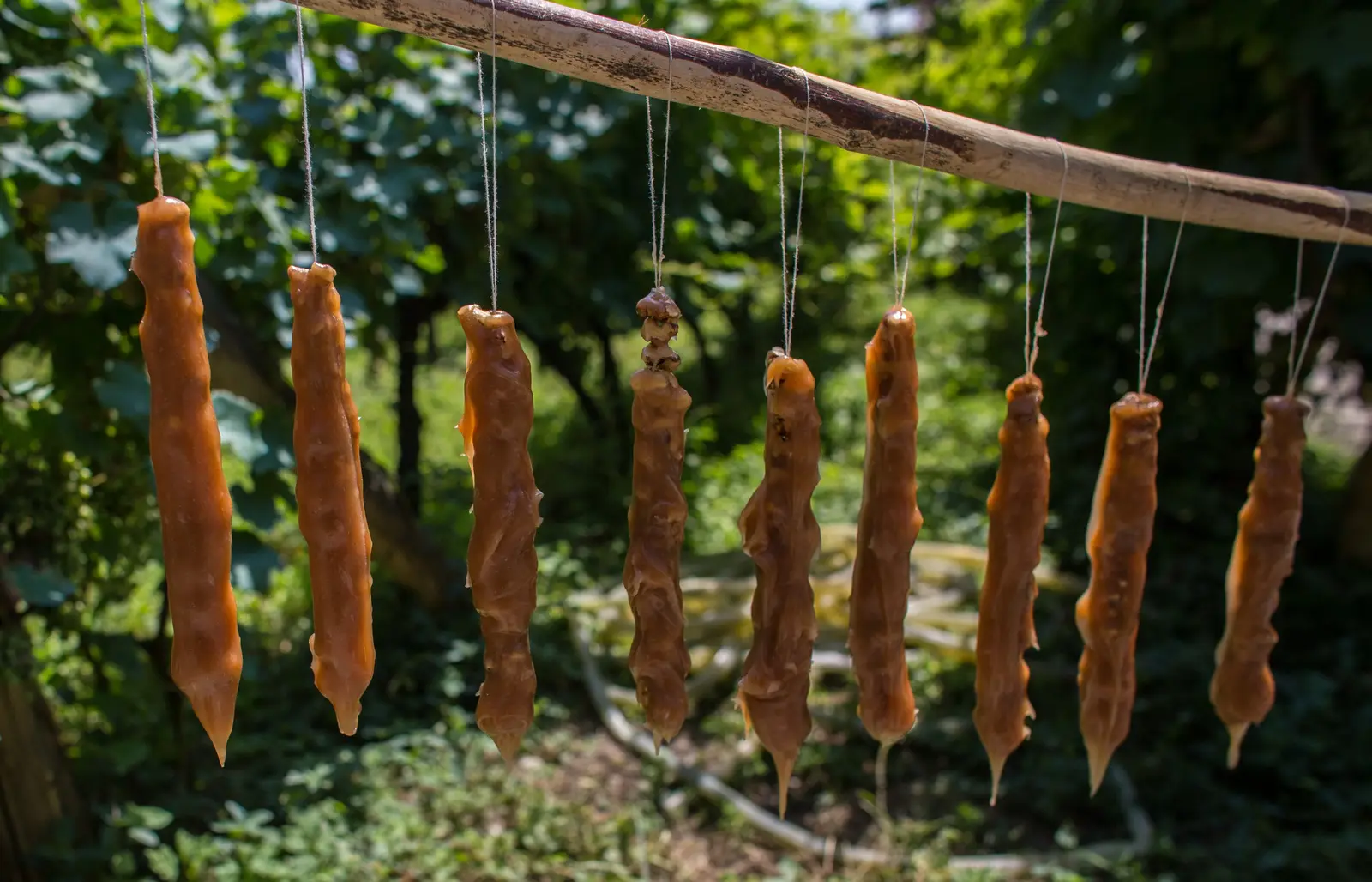
Walk through almost any market in Tbilisi this month and you'll see them before you smell the pickles or the bread: ropes of pale, waxy candy hanging from poles like strange candles, in shades from amber to deep plum. This is churchkhela, and if you've timed your visit for autumn, you've arrived exactly when it's supposed to be made.
Older than the sugar bowl
Churchkhela belongs to a category of sweets that predates refined sugar in Georgia entirely. Its only sweetness comes from grape must — the fresh-pressed juice left over once the wine harvest, or rtveli, is done. According to the food historian Darra Goldstein, the confection's dense, portable calories made it a staple for Georgian soldiers and travelers, who could carry it for days without it spoiling. In 2015, the traditional churchkhela-making technology of the Kakheti region, Georgia's main wine country, was added to the country's list of intangible cultural heritage, formally recognizing what households there have done every autumn for generations.
The method is simple in outline and exacting in practice. Walnut halves are threaded onto a length of string. The leftover grape must is slowly boiled down with wheat flour into a thick, glossy paste called tatara. Each string of nuts is dipped into the hot tatara, lifted out, and left to drip before hanging to dry — then dipped again, sometimes several times over, until the paste has built up into a firm, matte coating around the nuts. No sugar is added to the genuine version; the sweetness is entirely the grape's.
A sweet that changes with the map
What you're handed in a Tbilisi market is the eastern Georgian version, built on walnuts and grape-must tatara, typical of Kakheti, Kartli, and Meskheti. Cross the country and the recipe shifts with the local harvest. In western Georgia — Racha, Guria, Samegrelo — the same idea is made with hazelnuts and corn flour instead of wheat, and the condensed juice itself is called pelamushi rather than tatara. In Samtskhe-Javakheti, where grapes are scarcer, mulberry juice sometimes stands in for must. Western Georgian cooks also have their own cousin confection, janjukha, dipped a final time after roughly ten days of drying for an extra-thick shell.
“A string of walnuts, dipped again and again in the last of the grapes before they became wine.”
Where to find the real thing
Supermarkets and tourist kiosks around Rustaveli Avenue sell churchkhela too, but much of it is made fast with sugar syrup and food colouring rather than real tatara — it tends to be stiffer, almost plastic to the bite, and dyed in colours grapes don't actually produce. The better test is to go where Tbilisians buy their own: Dezerter Bazaar, the sprawling market by the central railway station, open daily from early morning into early evening. Stalls here sell it by weight, strung in long ropes you can ask to have cut to size, and vendors are generally happy to let you taste a piece before you commit. The colour should look like something a grape could plausibly have produced — pale gold to deep burgundy — and the texture should be dense and slightly chewy, not glassy.
- 01Where: Dezerter Bazaar, by Tbilisi's central railway station — look past the produce stalls near the entrance for vendors selling churchkhela by the string.
- 02When: Right now through late autumn is peak season, made fresh from this year's rtveli; it's sold year-round, but freshness and quality are best closest to harvest.
- 03How to tell it's real: matte, dense, slightly chewy, and coloured like actual grape must — not glossy or bright pink.
- 04How to get there: a short walk or taxi ride from Station Square (Tbilisi Central Station) metro stop.
- 05How to eat it: sliced into thin rounds, it's a between-meal snack across Georgia and keeps well for days if wrapped and kept somewhere cool and dry — making it one of the few Tbilisi treats that travels home in a suitcase.
It won't photograph as neatly as a plate of khinkali, and it won't come with a waiter to explain it. But a few hundred grams of good churchkhela, bought from someone who made it themselves this season, is as close as a visitor gets to tasting the harvest directly — grapes, pressed, boiled down, and hung out to dry, exactly as they have been for generations.
Sources